|
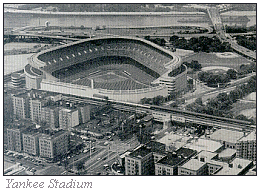  ith New York City facing the prospect of building new baseball parks to replace Yankee and Shea stadiums, the Independent Budget Office published a report in April 1998 that demonstrated both that new stadiums would generate about $20 million in city revenues and that the principal financial beneficiaries of new ballparks would be the baseball teams themselves. A second report, released in September, showed that the fans who attend major league games are mostly residents of the suburbs rather than the five boroughs. ith New York City facing the prospect of building new baseball parks to replace Yankee and Shea stadiums, the Independent Budget Office published a report in April 1998 that demonstrated both that new stadiums would generate about $20 million in city revenues and that the principal financial beneficiaries of new ballparks would be the baseball teams themselves. A second report, released in September, showed that the fans who attend major league games are mostly residents of the suburbs rather than the five boroughs.
The first study, Double Play: The Economics and Financing of Stadiums for the Yankees and the Mets, reported:
- The existing ballparks generate about $14 million in annual taxes and fees for the city's treasury and roughly $300 million in activity for the city's economy.
- Two new baseball stadiums would generate an additional $5 million annually in city tax and fee revenue. Most of the additional economic benefits of new stadiums would go to the teams and the players.
- Research from around the country has repeatedly found that new stadiums do not lead to overall economic growth for a metropolitan area, although they may relocate economic activity to a particular area or neighborhood.
"New York's major league franchises play in the largest income and media market in the country," said IBO's Stephen Mark, one of the authors of the report. "Their revenues far exceed league averages. Ideally, any plans to build new stadiums would take these realities into account and minimize the level of public investment needed to get any new stadiums built."
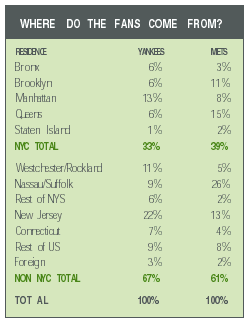 The second study, Home Base for Mets and Yankees Fans, reported IBO's finding from a survey of nearly 4,000 fans at weekday, weeknight, and weekend games at Yankee and Shea stadiums in August 1998 that asked fans for their ZIP codes. The study found that: The second study, Home Base for Mets and Yankees Fans, reported IBO's finding from a survey of nearly 4,000 fans at weekday, weeknight, and weekend games at Yankee and Shea stadiums in August 1998 that asked fans for their ZIP codes. The study found that:
- Nearly 67 percent of Yankee fans at the stadium came from outside the five boroughs, including 22 percent from New Jersey, 11 percent from Westchester/ Rockland counties, 9 percent from Nassau/Suffolk, and 6 percent from Connecticut.
- About 61 percent of Shea attendees were from outside New York City, including 26 percent from Nassau/Suffolk, 13 percent from New Jersey, 5 percent from Westchester/Rockland and 4 percent from Connecticut.
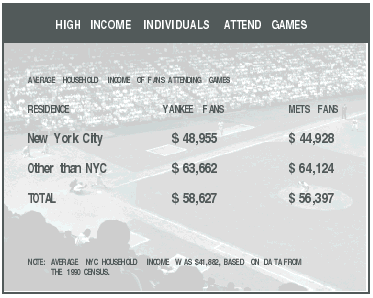
- Based on their zip codes, Yankees and Mets fans appear to come from households with an average income 40-50 percent greater than the average household income of New York City residents.
"Major league ballparks were once built with private funds," IBO Director Douglas Criscitello said. "If public funds must be used, the establishment of a regional taxing district would more accurately reflect the fan base attending games at the stadiums. Colorado and Wisconsin have used similar approaches for Coors Field in Denver and the under-construction Miller Park in Milwaukee. New York already has a model in the form of a regional tax district for the 12 counties served by the Metropolitan Transportation Authority. If area governments worked together to retain the teams, the public interest would be served by substantially improving the people's bargaining power."
|